Most Disney World rides work for most guests. But “most” doesn’t help much when you’re checking Disney World ride accessibility for someone with specific needs. Maybe they can’t leave their wheelchair, get overwhelmed in the dark, or panic at a sudden loud noise.
Disney publishes the details, but they’re spread across three places. There’s a sensory chart, a set of wheelchair access lists, and height and health notes on each attraction page. Families end up cross-checking all three, one ride at a time.
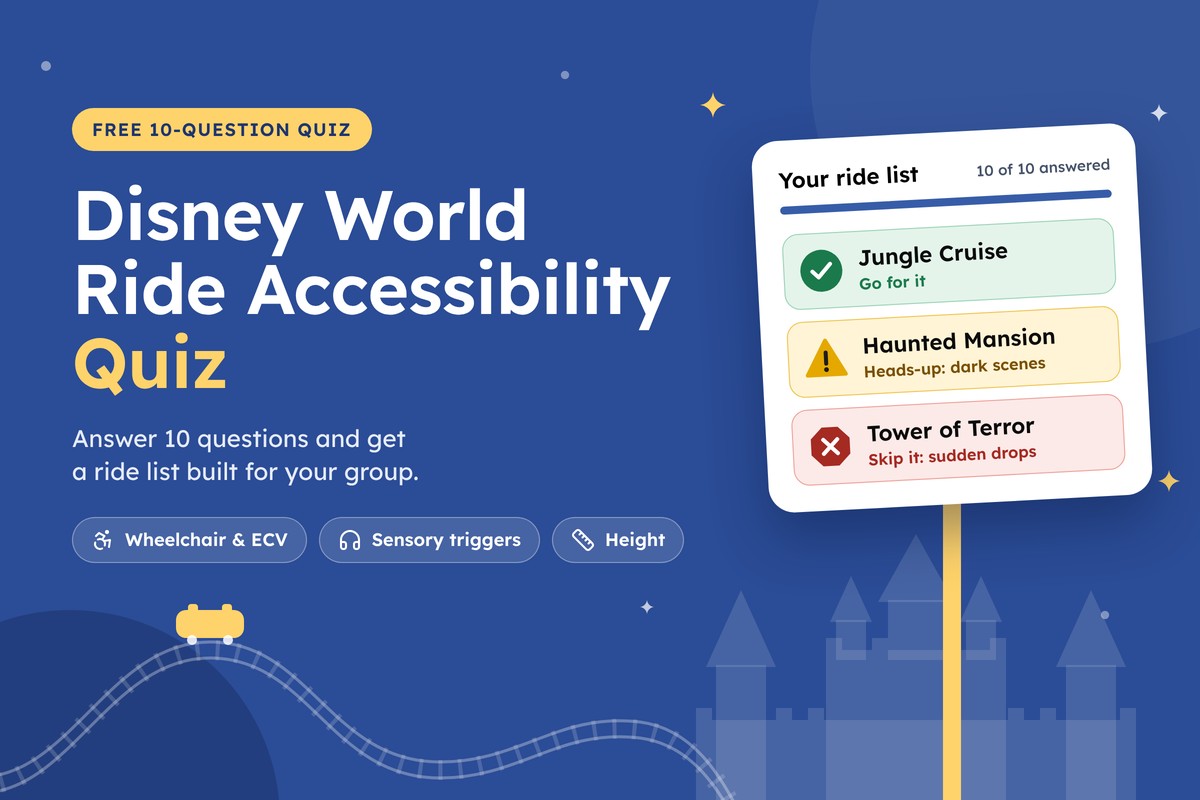
That’s why we built a free Disney World ride accessibility quiz that does the cross-checking for you. It does that cross-checking for you. Answer a few questions about your guest. From there, it sorts every major ride, show, parade, and trail in the four parks into a color-coded list.
Take Our Disney World Ride Accessibility Quiz
Tell the quiz how your guest gets around, how tall they are, and what’s hard for them. It takes up to 10 quick questions, covering everything from loud noises and darkness to drops and 3D glasses. It then checks Disney World ride accessibility for 82 attractions. Each one gets a color, with the reasons listed underneath.
How the Quiz Works
The quiz only asks what it needs. If no one in your group uses a wheelchair, you can skip the mobility questions. If noise and darkness aren’t a concern, you can skip the sensory ones. Here’s what it weighs:
- Parks: one park or all four.
- What to check: getting on rides, sensory triggers, or both.
- Getting around: whether your guest walks on their own, uses a wheelchair or ECV part of the time, can transfer into a ride seat, or needs to stay in their chair.
- Device: a wheelchair, an ECV, or a stroller used as a wheelchair. Some rides fit wheelchairs but not ECVs.
- Height: rides with a higher minimum turn red.
- Health advisories: Disney’s warnings at many thrill rides about pregnancy, heart conditions, back and neck problems, and motion sickness.
- Sensory triggers: 15 options, from loud noises and darkness to scents, spinning, and snug restraints.
- How strict to be: for each trigger, skip those rides, allow brief moments, or just get a warning.
- Time limit: how long your guest can stay in one ride or show.
- Waiting in line: this doesn’t change any colors, but it decides which line tools show up in your results.
What Each Color Means
Each attraction gets one of three colors:
- Go for it: nothing conflicts with your answers.
- Heads-up: it’s doable, with something to know first, like a transfer or a brief dark scene.
- Skip or check first: something doesn’t fit, so ask a Cast Member before you try it.
Every card explains its color, and you can print or copy your list to take to the park.
Where the Ride Info Comes From
The quiz is built on Disney’s Sensory Experience Details, wheelchair and ECV access lists, and posted height requirements. Several rides changed recently, and your results reflect that:
- Big Thunder Mountain Railroad reopened in May 2026 with a lower 38-inch height requirement.
- Rock ’n’ Roller Coaster Starring The Muppets opened in May 2026.
- DINOSAUR closed along with the rest of DinoLand U.S.A.
- Tom Sawyer Island and Liberty Square Riverboat closed in 2025 to make room for a new Cars area.
- Zootopia: Better Zoogether! took over the theater inside the Tree of Life.
Wheelchair Accessible Rides at Disney World
Disney sorts every attraction into one of five access levels. Knowing which level each ride falls under makes the day much smoother, especially at rides with a separate entrance or boarding area.
Disney’s Five Wheelchair and ECV Access Levels
- May remain in wheelchair or ECV: you stay in your device the whole time. This covers most theater shows, parades, and fireworks, plus Wildlife Express Train and Gorilla Falls Exploration Trail.
- Must transfer from ECV to wheelchair: the ride vehicle fits a wheelchair but not an ECV. ECV users switch to a wheelchair Disney provides at the attraction. “it’s a small world,” Jungle Cruise, Remy’s Ratatouille Adventure, Toy Story Mania!, and Kilimanjaro Safaris work this way.
- Must transfer from wheelchair or ECV to ride vehicle: you move into the ride seat on your own or with help from your party. Most coasters and thrill rides fall here, including Big Thunder Mountain Railroad, Haunted Mansion, Test Track, and Expedition Everest.
- Must transfer from ECV to wheelchair, then to ride vehicle: ECV users switch to a Disney wheelchair first. From there, everyone transfers into the ride seat. This setup covers Pirates of the Caribbean, Space Mountain, TRON Lightcycle / Run, and Slinky Dog Dash. The Twilight Zone Tower of Terror and Avatar Flight of Passage work this way too.
- Must be ambulatory: you need to walk on your own or with help. At Magic Kingdom, that includes Swiss Family Treehouse, Peter Pan’s Flight, and the Tomorrowland Transit Authority PeopleMover.
Transfer Tools and Accessible Vehicles
Many rides have tools that make boarding easier:
- Dedicated load and unload areas: separate boarding spots for guests with disabilities.
- Wheelchair Access Vehicles: let you ride without transferring at all.
- Transfer Access Vehicles: have features like a folding bolster or a swinging door.
- Transfer devices: help you move between your chair and the ride seat.
Tools vary by attraction, so tell the Cast Member at the entrance what you need. Guests who use a seat cushion every day can also bring it on select rides.
Renting instead of bringing your own? Our guide to renting wheelchairs and ECVs at Disney World covers prices and pickup. If your guest could use either one, a wheelchair saves you the extra switch at some rides.
Sensory Friendly Rides at Disney World
Disney World is loud, bright, and busy by design, but the sensory load varies a lot from ride to ride. A gentle boat ride and an indoor coaster can sit just a few steps apart.
What Disney’s Sensory Guide Tracks
Disney’s Sensory Experience Details rates each attraction on these elements:
- Scents and smells: added scents, or fumes like the gas engines at Tomorrowland Speedway.
- Lighting effects: specialty lighting and visual effects.
- Loud noises: including startling or surprise sounds.
- Periods of darkness: low light or total darkness.
- Bumpy: sudden movements, simulated motion, or small dips.
- Fast: quick forward motion or bursts of speed.
- Lifts off the ground: the vehicle rises, or the track runs high with little view ahead.
- Wet: a strong chance of getting splashed.
- Element of surprise: effects you might not see coming, in the queue or on the ride.
The guide also lists each ride’s restraint type and length. Our quiz adds notes on how strong each effect is. It also covers things families ask about most, like drops, spinning, enclosed spaces, scary characters, and 3D glasses.
Calm Rides in Each Park
These attractions have the fewest sensory elements in Disney’s guide. Every guest is different, so check the details for anything that matters to you.
- Magic Kingdom: Walt Disney’s Carousel of Progress, Prince Charming Regal Carrousel, and “it’s a small world.” Under the Sea ~ Journey of the Little Mermaid is another gentle pick.
- EPCOT: Turtle Talk with Crush, Canada Far and Wide, Spaceship Earth, and The Seas with Nemo and Friends. The Seas does have one scary-fish scene.
- Hollywood Studios: Vacation Fun and Beauty and the Beast – Live on Stage. This park has the fewest gentle rides, so plan on more show time here.
- Animal Kingdom: Wildlife Express Train, Gorilla Falls Exploration Trail, Maharajah Jungle Trek, and Na’vi River Journey. Na’vi River Journey is a slow, dark boat ride through a glowing forest.
Rides With the Biggest Surprises
Some rides catch people off guard even when they look tame from the outside:
- Haunted Mansion: the pre-show room goes completely dark for a moment before you board.
- Journey into Imagination with Figment: one room turns dark and loud with a simulated train. Another has a skunk-scent gag.
- Mission: SPACE: you ride in a small, closed capsule with an over-the-shoulder restraint.
- Avatar Flight of Passage: the seat presses against your legs and back, and you wear 3D glasses.
- Star Wars: Rise of the Resistance: it lasts about 15 minutes, with several scenes and villains along the way.
For more on ride intensity, see our rundowns of the scariest rides at Disney World and the park’s high-intensity rides.
Height Requirements, Health Advisories, and Ride Length
Height is the one rule Disney won’t bend. Twenty-one rides across the four parks have a minimum. The tallest are TRON Lightcycle / Run and Rock ’n’ Roller Coaster Starring The Muppets, at 48 inches. Our guide to Disney World height requirements lists every one. The height requirement calculator shows what your child can ride today.
Many thrill rides also post a health advisory. Disney says riders should be in good health. Guests with high blood pressure, heart, back, or neck problems, or motion sickness should skip those rides. So should expectant mothers and anyone with a condition the ride could aggravate. The quiz marks those rides red if an advisory applies to your guest. Spinners and simulators like Mad Tea Party and Soarin’ get a heads-up for motion sickness.
Length matters too. Most rides last under 10 minutes, but shows like The American Adventure, Festival of the Lion King, and Fantasmic! run about 30 minutes. If sitting still is hard, the time question flags anything over your limit.
Lines, DAS, and Other Queue Options
For some guests, the line is harder than the ride. Disney offers several options, and your quiz results show the ones that fit.
Disability Access Service (DAS)
- Who it’s for: guests with a developmental disability, like autism, who can’t wait in a regular line for long.
- How to register: a live video chat with a Cast Member, up to 60 days before your visit. There’s no in-person registration.
- How it works: once approved, your party of up to four gets return times based on the standby wait. You can hold one return time at a time.
- How long it lasts: the length of your ticket or up to one year.
- More detail: our guide to what disabilities qualify for DAS walks through the process.
Other Ways to Handle Lines
- Attraction Queue Re-Entry or Meet-Up: a guest can step out of line while the party keeps its place. They can also wait outside and meet the group before boarding.
- Rider Switch: if someone can’t or doesn’t want to ride, your group takes turns without waiting in line twice.
- Single Rider: available at select rides. Disney says these lines are often shorter and have fewer sensory elements than the standard queue. Your group does ride separately, though.
- Stroller as a Wheelchair tag: for guests with a disability who use a stroller as their mobility device. Ask at Guest Relations.
- Lightning Lane: paid passes that shorten waits for anyone. Our Lightning Lane overview explains how they work.
Quiet Places and Break Areas
Every park has spots that are usually a little less busy. Disney lists several in its accessibility planning guide, including:
- Center Street, off Main Street, U.S.A.
- The Japan pavilion garden at EPCOT
- The corridor between Toy Story Land and Star Wars: Galaxy’s Edge
- Maharajah Jungle Trek at Animal Kingdom
First Aid in each park is another calm place to reset. Companion Restrooms give extra space and privacy for guests who need help. Your quiz results list break spots for each park you choose. Our guide to places to relax at Disney World has more ideas.
Planning Tips for Guests With Disabilities
Planning ahead makes a big difference, especially for guests who do best with a routine:
- Preview the day: a visual schedule helps guests know what’s coming. Disney suggests building one around the fixed times, like park entry and showtimes. Our guide to Disney World with autism has more ideas for neurodivergent kids.
- Pack for comfort: bring noise-canceling headphones or earplugs, sunglasses, a favorite calming item, and snacks.
- Choose parks with your energy in mind: the walking adds up fast. Here’s which Disney park has the least walking.
- Plan your transportation: buses, the monorail, and the Skyliner are accessible. Boat access depends on the boat and the water conditions. The Disney World transportation map shows how it all connects.
- Ask about assistive technology: Disney’s Handheld Device offers audio description, assistive listening, and handheld captioning. Pick one up at Guest Relations for a $25 refundable deposit.
- Traveling with grandparents: our tips for Disney World for seniors cover pacing and rest breaks.
For everything beyond rides and accessibility, our ultimate Disney World planning guide covers the rest of your trip.
Plan an Accessible Trip With a Travel Advisor
Once you know which rides are a go, the next step is building park days around them. That means breaks in the right places and an accessible room if you need one. A Disney travel advisor can handle all of that, and it doesn’t cost you anything extra.
The Vacationeer is a Diamond-level EarMarked by Disney Authorized Travel Agency and our top pick among the best Disney travel agencies. Their Disney planners can build your days around your quiz results and request an accessible room. They’ll also help with dining needs and book everything at no planning fee.
Use the button below to get your free Disney World quote.
Disney World Ride Accessibility FAQs
Which Disney World rides can you stay in a wheelchair on?
Most theater shows, parades, and nighttime spectaculars let you stay in a wheelchair or ECV. Several rides also have a wheelchair-accessible vehicle, including “it’s a small world,” Jungle Cruise, and Toy Story Mania! Buzz Lightyear’s Space Ranger Spin, Remy’s Ratatouille Adventure, and Kilimanjaro Safaris do too. ECV users switch to a Disney wheelchair at those rides.
Can ECV users ride everything at Disney World?
No. ECVs can’t board ride vehicles. Some rides have you switch to a Disney wheelchair, and many require a transfer into the ride seat. A few, like Peter Pan’s Flight and Swiss Family Treehouse, require guests to walk.
Which Disney World rides are best for sensory-sensitive guests?
Slow rides and shows with few effects are the safest bet. Try Walt Disney’s Carousel of Progress, Turtle Talk with Crush, Spaceship Earth, or Wildlife Express Train. Triggers are different for everyone, so run your guest’s specifics through the quiz above.
Does Disney World have a sensory guide?
Yes. Disney publishes its Sensory Experience Details for each attraction. It lists scents, lighting effects, loud noises, darkness, bumps, speed, height, water, and surprises. It also notes restraint types and ride times.
Who qualifies for DAS at Disney World?
DAS is for guests with a developmental disability, like autism, who can’t wait in a regular line for long. Disney decides eligibility in a live video chat, which you can request up to 60 days before your visit.
Are there quiet places at Disney World?
Yes. Every park has quieter break areas, and First Aid is a calm place to rest. Ask any Cast Member for the nearest one.
Can you bring noise-canceling headphones to Disney World?
Yes. Disney recommends earplugs or headphones in its accessibility planning guide. Fireworks, announcements, and fast rides can all be loud.





Leave A Comment